MKV is a flexible container: one file can carry modern video, several audio languages, subtitles, chapters and attachments. MP4 is less flexible, but it is the safer delivery format for browsers, phones, messaging apps and many TVs. A good MKV-to-MP4 workflow therefore starts by asking what must be preserved—not by pressing Convert immediately.
Why MKV may not play while MP4 does
The file extension identifies the container, not the video codec inside it. An MKV may contain H.264, HEVC, AV1 or another stream. MP4 can also carry several codecs, but playback devices commonly expect H.264 video and AAC audio. Converting the container without understanding the streams can create a file that is technically MP4 yet still incompatible.
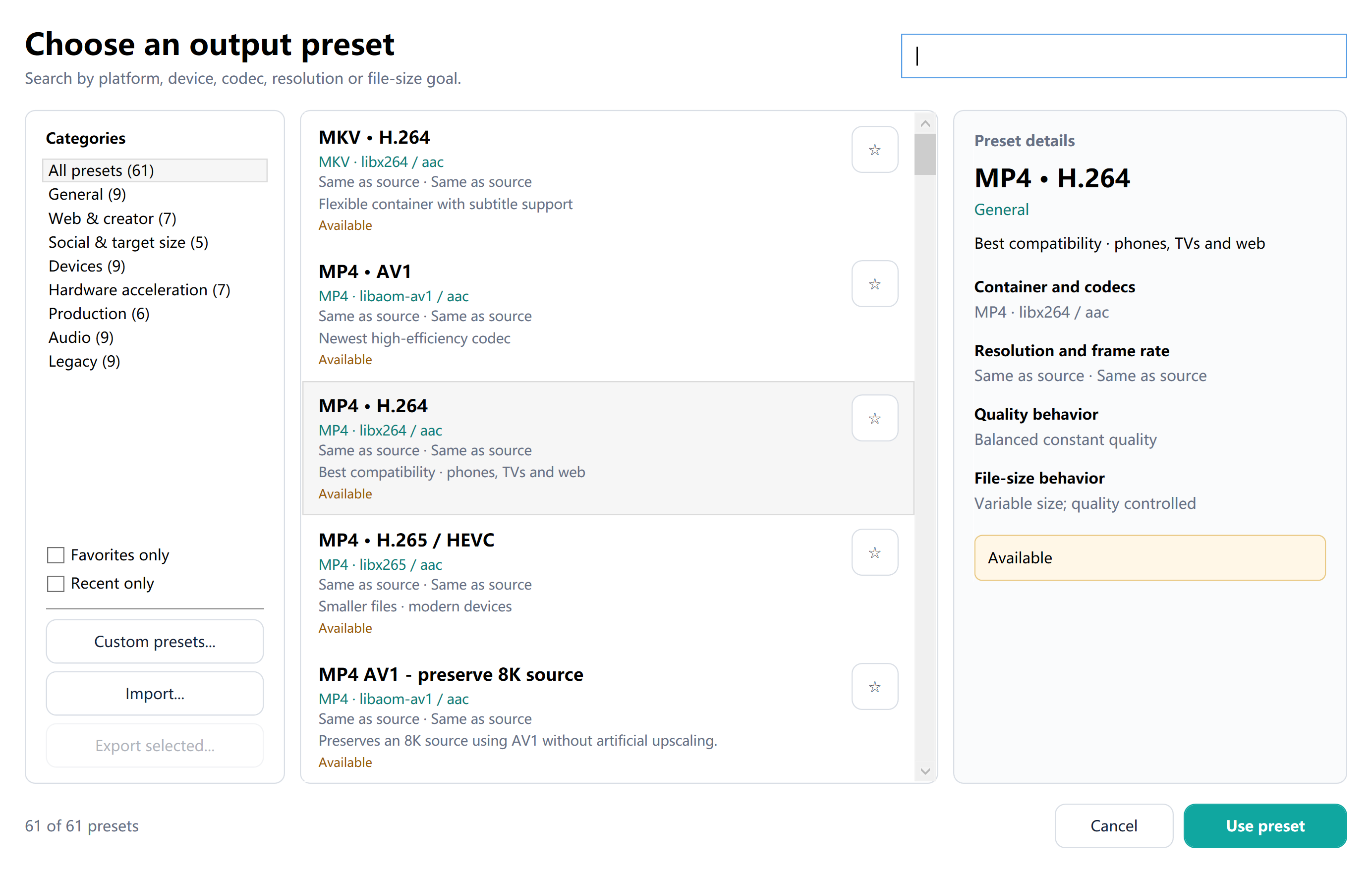
For maximum reach, choose MP4 H.264 with AAC audio. If every destination supports HEVC, MP4 H.265 can reduce size at comparable quality but takes more work to encode and is less universal. AV1 is efficient for newer software but remains the most demanding compatibility choice.
How to convert MKV to MP4
- Add the MKV. Use Add files and confirm that duration, resolution and the source codec look reasonable.
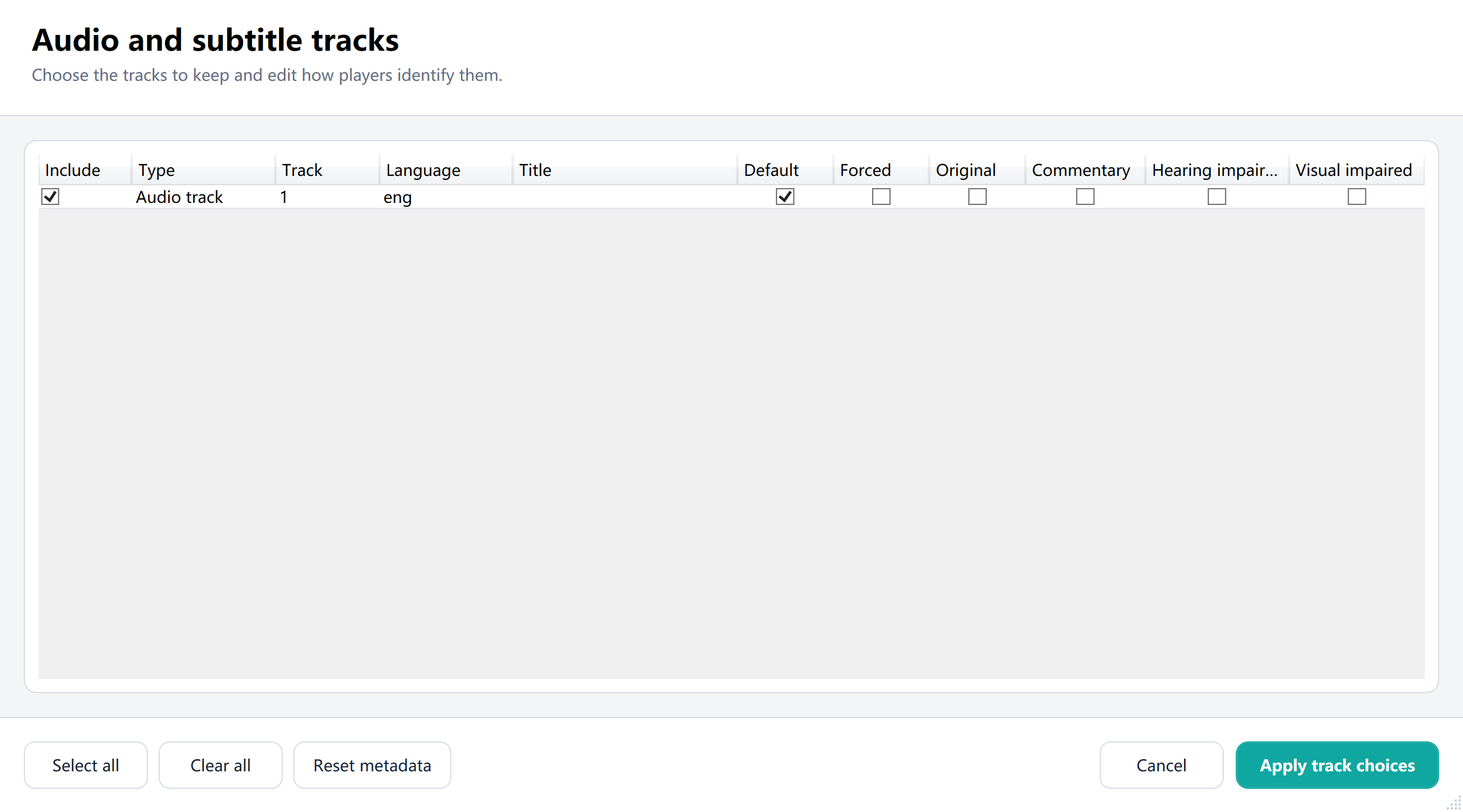
- Inspect tracks. Open Tracks. Include each audio or subtitle stream you want to keep. Set the intended default audio and forced subtitle flags.
- Choose a preset. Browse presets and select MP4 H.264 for ordinary playback, or MP4 H.265 when you control the destination.
- Decide whether to copy or encode. Automatic join/stream handling may preserve compatible streams, but a compatibility-oriented preset will encode when necessary.
- Choose a new output name. Never overwrite the source during the first pass.
- Verify. Play the beginning, middle and end; switch audio tracks; enable subtitles; and check total duration.
What happens to subtitles and audio?
MP4 supports a narrower set of subtitle and attachment behaviors than MKV. Text subtitles may be retained when compatible; image-based subtitles may need a different container or burn-in. If exact subtitle preservation matters more than device compatibility, output MKV may be the better answer. The Tracks window exposes language, title, default, forced, commentary and accessibility metadata so the decision is visible.
How to avoid unnecessary quality loss
Every lossy re-encode discards information. Use same-as-source resolution and frame rate unless you have a specific delivery requirement. Start with a balanced constant-quality value, then inspect motion, faces, gradients and text. A target file size is helpful for upload limits, but it may spend too few bits on a complex video. Two-pass mode improves allocation when size matters more than speed.
MKV to MP4 FAQ
Can MKV be changed to MP4 without re-encoding?
Sometimes. If the video, audio, subtitles and metadata are compatible with MP4, remuxing can be fast and lossless. Otherwise at least one stream must be converted or omitted.
Does conversion remove multiple audio tracks?
Only tracks excluded by your selection or unsupported by the output container should be omitted. Inspect the Tracks window before conversion and test the finished file.
Will a 4K MKV stay 4K?
Yes when the output resolution is Same as source. A device or size-target preset may deliberately reduce it.
Try the workflow locally
Free Video Converter keeps local source files on your Windows PC and gives you explicit control over output names and settings.
Download Free Video Converter