HEVC (H.265) can deliver good quality at lower bitrates than H.264, but H.264 remains easier to play on older PCs, browsers, TVs, presentation systems and editing tools. Converting HEVC to H.264 is therefore a compatibility decision—not an automatic quality upgrade.
Why HEVC may not play
Microsoft's current codec documentation says H.265 support is not present on every device and may depend on the optional HEVC Video Extension. H.264 is included much more broadly. The official Windows codec matrix also shows why a file extension alone cannot guarantee playback: MP4 and MKV can contain different video streams.
How to convert H.265 to H.264
- Add the HEVC file and inspect resolution, frame rate, bit depth, HDR metadata, audio and subtitles.
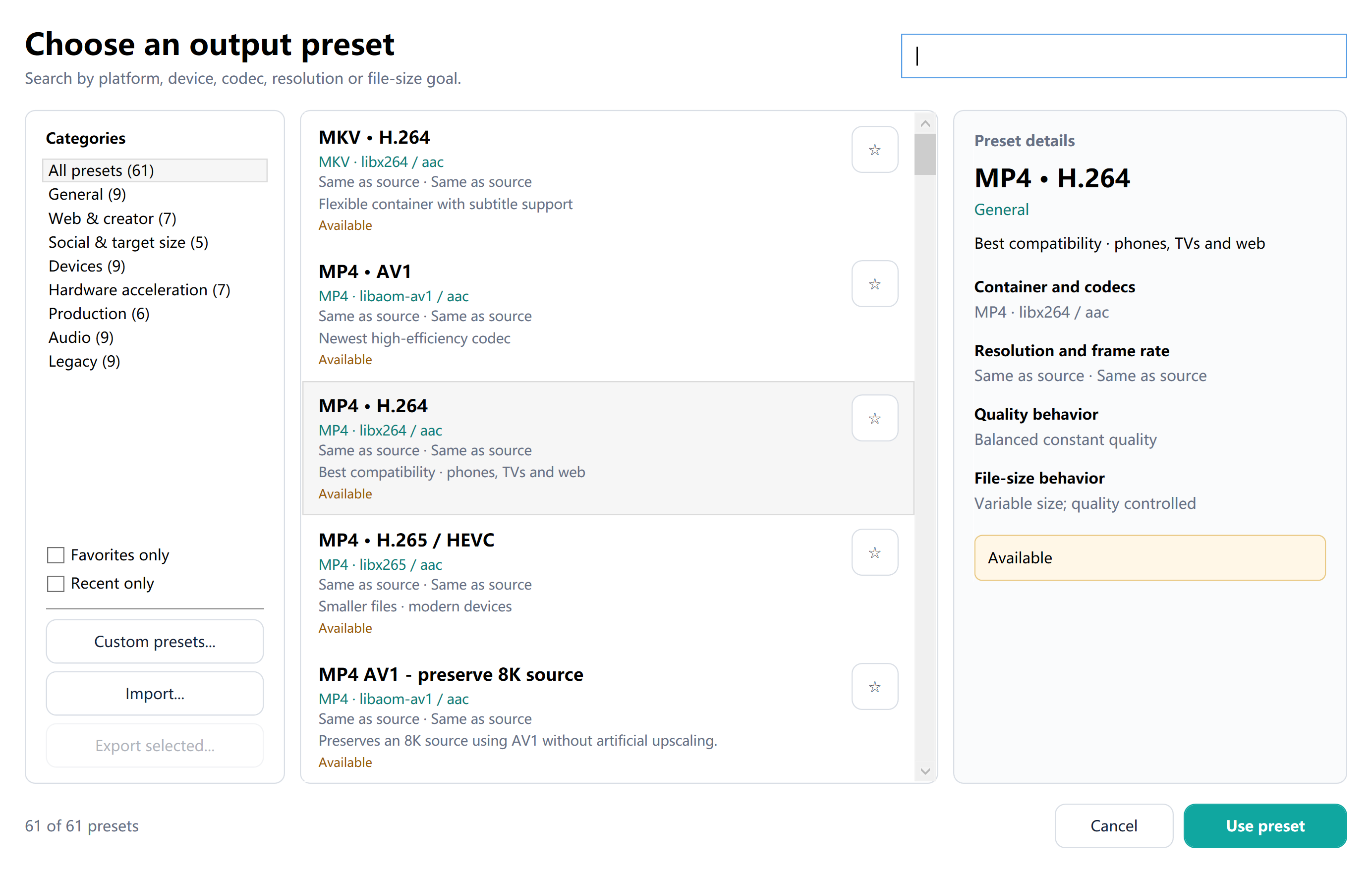
- Choose an MP4 H.264 preset for ordinary compatibility.
- Leave resolution and frame rate unchanged unless the destination has a specific limit.
- Select AAC for broad audio support, or retain another compatible audio stream when the target accepts it.
- For SDR output from HDR input, select an intentional HDR/tone-mapping behavior. Do not silently strip metadata and assume the picture is correct.
- Choose constant quality for visual consistency or target-size/two-pass for a fixed limit.
- Write a new file and verify full playback and audio synchronization.
Will conversion lose quality?
Usually yes at a technical level: HEVC-to-H.264 conversion normally decodes and re-encodes the video, and lossy encoding discards information. The goal is to make that loss unobjectionable at the intended viewing size. Avoid unnecessary scaling and frame-rate changes. Use a short difficult segment—motion, hair, water, gradients and text—to compare settings before converting a long file.
10-bit and HDR cautions
A 10-bit HEVC HDR source may need a 10-bit H.264 profile that the target still cannot decode, or an SDR conversion that changes its appearance. Decide whether the target is HDR-capable. If it is not, evaluate tone mapping on a calibrated or at least known display. Check color, highlights, skin tones and shadow detail; a successful exit code is not enough.
When not to convert
- If the destination already plays the HEVC file reliably, conversion wastes time and loses some information.
- If the file is an archive master, keep it and create H.264 as a delivery copy.
- If only the container is wrong and every stream is compatible, remuxing may be preferable—but H.265 itself remains H.265 after a remux.
- If the file is damaged, conversion may stop or conceal only part of the problem. Preserve the original and diagnose it first.
HEVC to H.264 FAQ
Can I just rename .mkv to .mp4?
No. Renaming does not change either the container structure or the codec. Use a verified remux or transcode workflow.
Why did the file become larger?
H.264 often needs more bitrate than HEVC for similar quality. Rate-control settings also may have targeted a higher quality than the source required.
Does H.264 solve every playback issue?
No. Container, profile, level, resolution, frame rate, audio codec and file integrity still matter.
Try the workflow locally
Free Video Converter keeps local source files on your Windows PC and gives you explicit control over output names and settings.
Download Free Video Converter