WebM is designed for web media and commonly contains VP8, VP9 or AV1 video with Vorbis or Opus audio. MP4 is a different container and is commonly delivered with H.264 video and AAC audio. The safest WebM-to-MP4 conversion therefore checks both streams instead of assuming the container is the only difference.
WebM and MP4 are containers
A container organizes video, audio, subtitles and metadata. MDN's official container guide documents WebM and MP4 combinations, while its video codec guide explains codec-level trade-offs. A VP9+Opus WebM usually cannot become a broadly compatible H.264+AAC MP4 by changing only the outer container; the streams need conversion.
Convert WebM to MP4 on Windows
- Add the WebM and confirm the video and audio codecs.
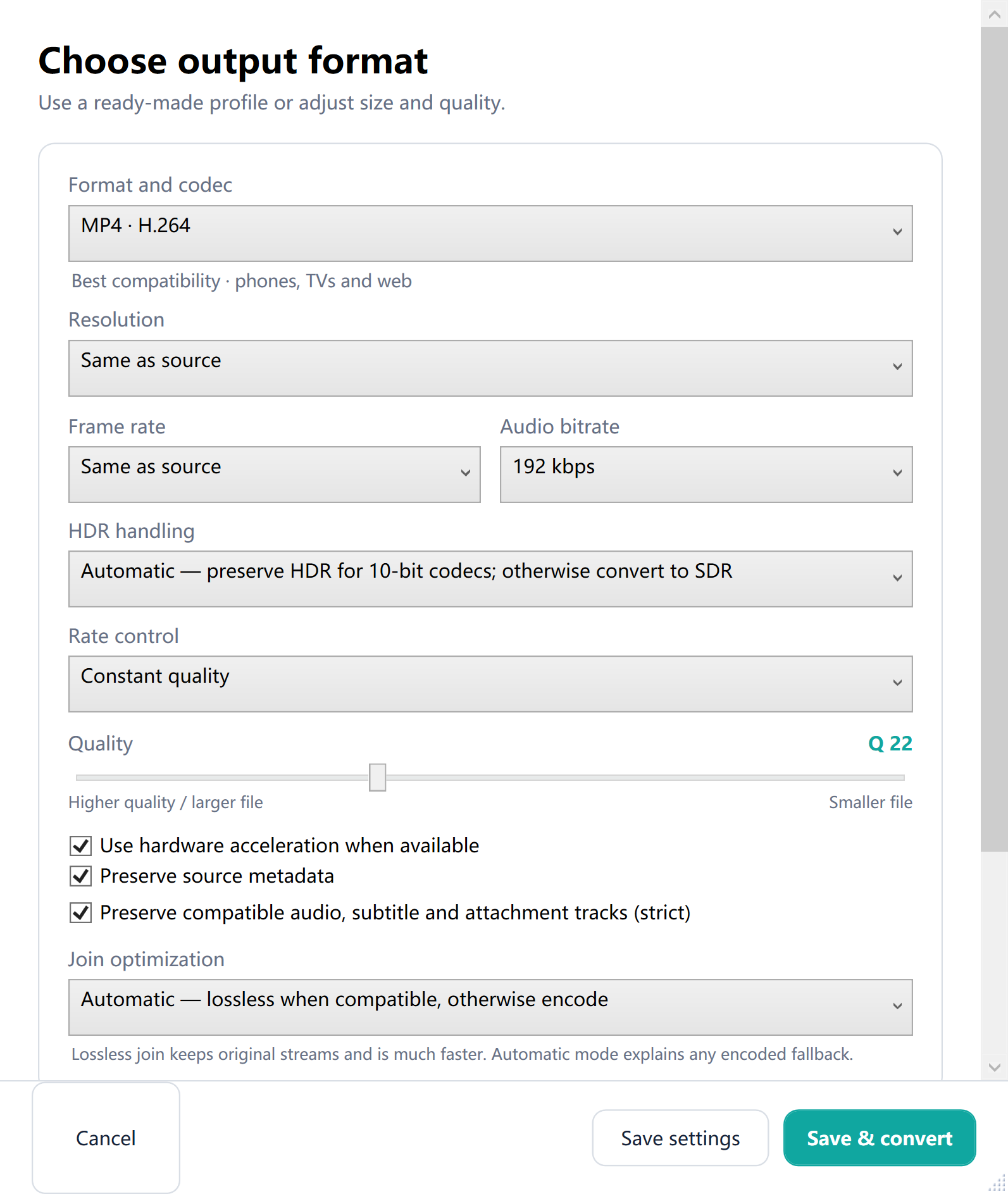
- Choose MP4 H.264 for the widest ordinary playback compatibility.
- Use AAC audio when the destination does not document Opus-in-MP4 support.
- Keep same-as-source resolution and frame rate unless the destination has a limit.
- Choose quality or target-size mode according to the delivery requirement.
- Convert to a new name, leaving the WebM untouched.
- Decode the complete MP4 and inspect duration, audio sync and the final frames.
Avoid silent or incompatible audio
Opus is efficient and widely used in WebM, but AAC remains the conservative companion for H.264 MP4 delivery. Do not disable the audio track accidentally when choosing streams. For speech, inspect lip synchronization; for music, compare transients and stereo image. If the source contains several tracks, use the track selector rather than relying on the first one.
Transparency and animation
Some WebM files use transparency or unusual frame timing for overlays and animations. An ordinary H.264 MP4 output may not preserve an alpha channel. Decide whether the destination needs transparency before converting. If it does, choose a format and codec that explicitly support that workflow rather than treating a black background as a successful result.
Troubleshooting
| Symptom | Likely cause | Action |
|---|---|---|
| MP4 has no sound | Audio track omitted or incompatible | Select the intended track and encode AAC |
| File is much larger | High H.264 quality/bitrate | Compare constant-quality or target-size settings |
| Black background replaces transparency | Alpha unsupported by chosen H.264 output | Use an alpha-capable destination workflow |
| Playback ends early | Source timing or damaged media | Inspect source timestamps and run a full decode |
Batch-converting several WebM files
Inspect a representative sample before applying one preset to a folder. Animated overlays, screen recordings and downloaded conference clips may all be WebM while using different codecs, dimensions, frame rates and audio layouts. Set a queue default only after identifying those differences; override individual jobs that need transparency, a different audio track or a fixed frame rate. Use a clean output directory so same-name files from different source folders cannot collide. After conversion, compare the expected job count, durations and stream counts, then decode each finished MP4 rather than treating a green queue status as proof.
WebM to MP4 FAQ
Can WebM be remuxed to MP4 instantly?
Only when the contained streams are accepted by the target MP4 workflow. VP9/AV1 and Opus compatibility varies, so H.264/AAC conversion is the safer general answer.
Will online sites upload my video?
Online conversion normally requires upload. Free Video Converter processes local files locally.
Does MP4 always look better?
No. Quality depends on the source and encoding settings, not the extension.
Try the workflow locally
Free Video Converter keeps local source files on your Windows PC and gives you explicit control over output names and settings.
Download Free Video Converter