“Free 4K video converter with no watermark” is a high-intent search, but it combines three different questions: can the app read a 4K source, can it produce a 4K output, and will that output retain useful detail without an added logo? Free Video Converter supports 4K-oriented conversion controls and does not add a watermark, but a correct result still depends on codec, bitrate, hardware, source quality and destination support.
What 4K conversion actually changes
3840×2160 pixels describe frame dimensions, not quality. A heavily compressed 4K source may contain less usable detail than a clean 1080p master. Converting 1080p to 4K increases pixel count but does not restore missing texture. If the goal is compatibility, keep 4K only when the destination supports it; if the goal is a smaller upload, 1080p may be the more honest trade-off.
Recommended starting settings
| Goal | Video | Audio | Check |
|---|---|---|---|
| Broad 4K playback | MP4 H.264, 3840×2160, same frame rate | AAC | File size and device limits |
| Smaller modern file | MP4 HEVC/H.265, same resolution/frame rate | AAC | HEVC decoder availability |
| Modern browser test | WebM VP9 or AV1 | Opus | Target browser/device matrix |
| Strict upload limit | Target-size or two-pass mode | AAC at a known bitrate | Final size and full decode |
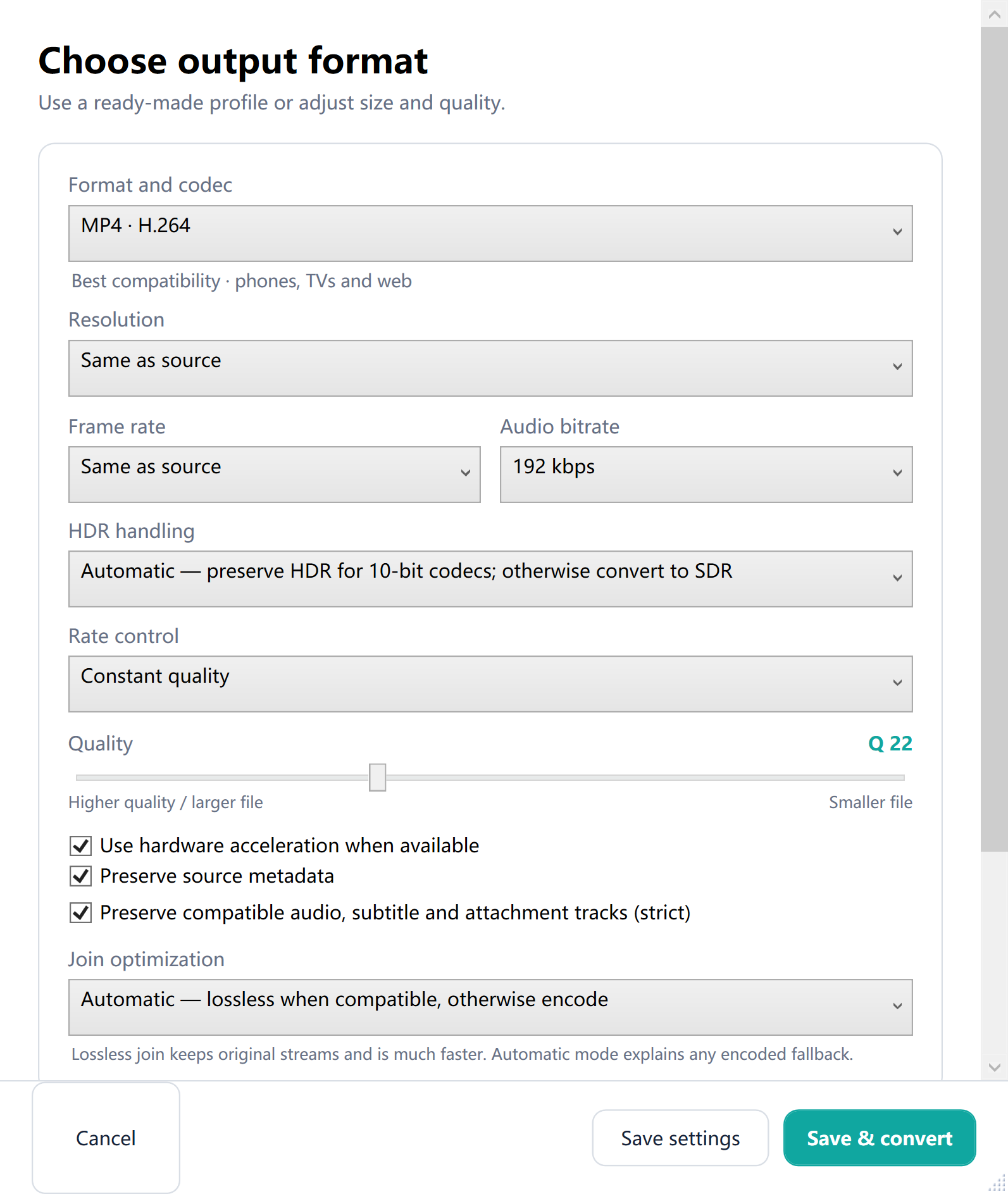
Convert 4K without a watermark
- Add the source and confirm it is genuinely 3840×2160 (or the expected cinema 4K size).
- Open the track selector and keep only the audio/subtitle streams the destination needs.
- Choose Same as source for resolution and frame rate unless you intend to scale.
- Select H.264 for reach, HEVC for modern efficiency, or AV1 only when compatibility and encoding time have been evaluated.
- Use constant quality for visual consistency or target size/two-pass for a hard delivery limit.
- Convert to a new file. The app does not overlay its own watermark; only enable the user-controlled watermark tool when you want one.
- Decode the entire output and inspect high-motion detail, gradients, text, audio sync and HDR behavior.
HDR, 10-bit video and color
HDR is not preserved merely because the output remains 4K. Transfer characteristics, color primaries, bit depth, codec profile and playback display all matter. When converting HDR for a normal SDR destination, use an intentional tone-mapping choice and compare faces, highlights and shadows. For HDR playback, Microsoft notes that compatible hardware and codecs are required; see Microsoft's Windows HDR guidance.
Speed and hardware acceleration
Hardware encoding can be much faster, but availability and output behavior depend on the GPU, driver, codec, profile and settings. A “hardware” label is not a guarantee of better quality. Test a representative 30–60 second segment in both hardware and software modes, compare it at the same resolution and approximate size, and keep the result that fits your delivery goal.
4K converter FAQ
Will the output always stay 4K?
Only when the selected output resolution remains 4K. Device or size presets may intentionally downscale.
Can I remove somebody else's watermark?
This guide concerns the application's own output: it does not add a watermark. It does not promise removal of third-party ownership marks.
Why is the 4K file huge?
Resolution, duration, frame rate, codec and rate control all affect size. Use target-size/two-pass mode or a more efficient codec after checking compatibility.
Try the workflow locally
Free Video Converter keeps local source files on your Windows PC and gives you explicit control over output names and settings.
Download Free Video Converter